Editing
Part of Video production budgets and schedules
Scheduling feedback without delaying the edit
Set purposeful review windows, consolidate video comments and give editors clear decisions before the next cut.
undefined
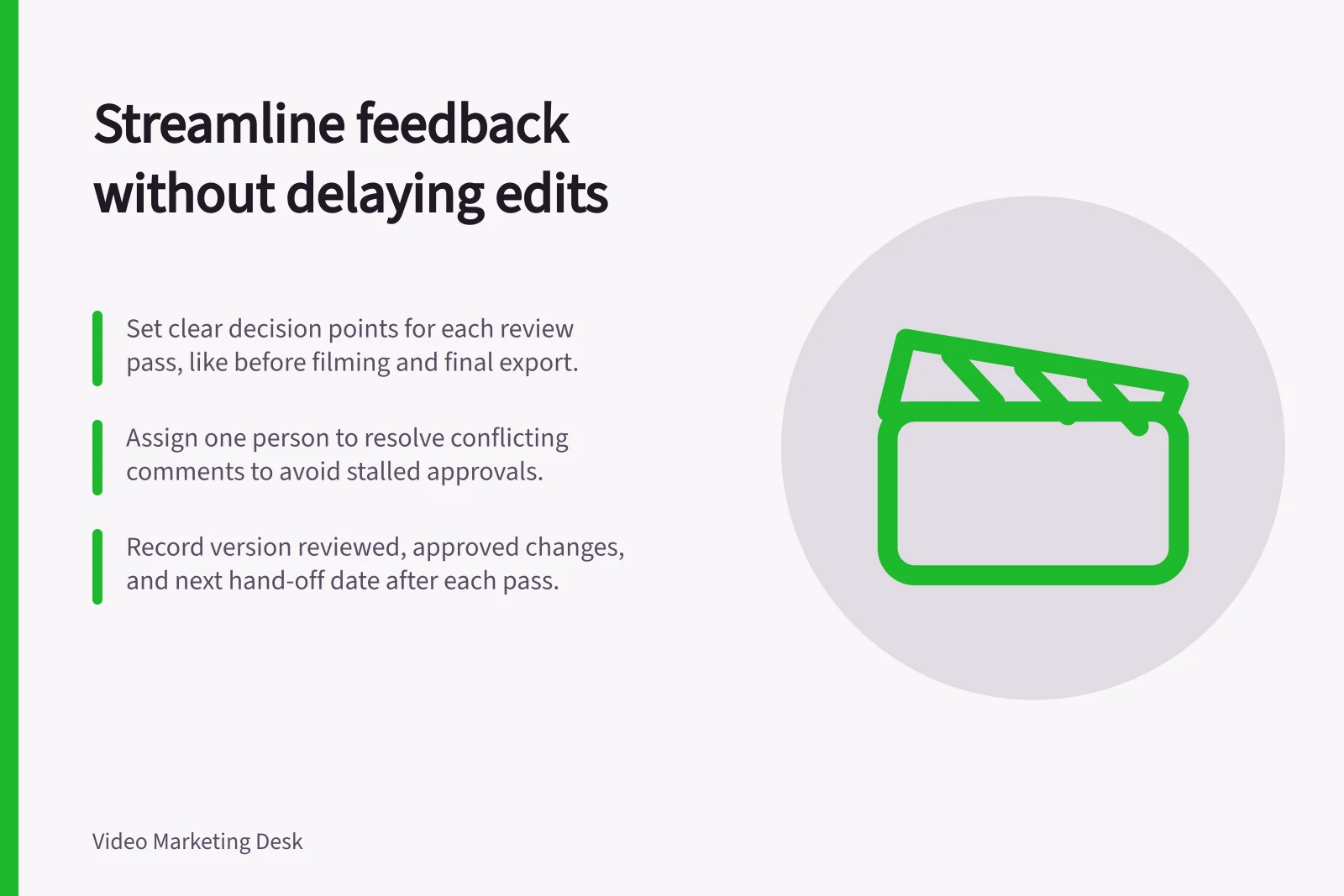
Book review slots before filming and tie each one to an agreed cut-delivery date. Assign a person to manage the schedule, set a consolidated response deadline for every pass and reserve editor time after each cutoff. Resolve conflicting notes before the editor receives changes, so the edit does not stall on an undefined approval or reopen for late feedback.
Set review points by decision
Give each pass a purpose, and book review holds with the producer when production dates are set, before filming. Check the script or outline before filming for factual accuracy and missing conditions. Use the first cut to assess whether the sequence answers the viewer’s question.
For planning, Ivory Media says a rough cut is usually delivered within 5 to 7 business days of wrapping the shoot; set the actual review hold from your agreed delivery date (ivorymedia.com.au).
Use a revised cut to check agreed changes. Check the final exported files, including captions and any transcript, before release.
These are suggested decision points, not a mandatory number of revision rounds. A small project may combine them; a sensitive claim may need a specialist check. Invite people only to decisions they can make.
Before filming, hand back approved wording or a named unresolved issue. On the first cut, return consolidated changes tied to a timecode or scene; on the revised cut, check that agreed changes were made and separate any new requests from corrections. On the final export, check the delivered assets and return either the release decision or the exact fault that blocks release.
Give reviewers enough context
Send the current version, viewer question, deadline and review scope in a Frame.io review link. Frame.io comments can be tied to an exact frame or a range of the video, helping the editor locate the issue (frame.io). Ask reviewers to identify the affected moment, the problem and the needed change.
“At the product result, the status label is unreadable; hold a closer view” gives the editor a clearer action than “make this clearer”. A time-specific comment can help locate a problem, but written notes work if they identify the moment precisely.
Name a producer or single point of contact to own the schedule and reconcile conflicting comments before the editor receives them. Ivory Media recommends nominating a single point of contact to consolidate internal feedback (ivorymedia.com.au). A product owner may correct a claim while a marketing reviewer wants different emphasis. The editor needs one agreed instruction and an owner for unresolved decisions. Separate factual corrections from preferences, and keep conditions attached to claims when shortening a passage.
Protect the edit window
At booking, the producer should put each review and editor hand-off in the production schedule against the agreed cut-delivery dates. Set consolidated feedback due 2 to 3 business days after receipt of each edit, following Ivory Media’s recommendation, and reserve editor time after the cutoff to assess, make and check changes (ivorymedia.com.au).
Example cadence: approve the script before filming; review the first cut; consolidate notes by the deadline; review the revised cut; check the final export before release. Book each reviewer and editor slot from the agreed cut dates, not from a guessed turnaround.
For a late request, first decide whether it corrects an error within the agreed scope or adds work. Accept an in-scope correction only if the editor can complete the change and checks within the reserved hand-off; otherwise, have the decision owner defer it or approve a revised delivery date before work reopens. Record the cut reviewed and which comments were accepted, deferred or rejected. After edits to speech or on-screen information, recheck affected captions, transcript and graphics.
Make the next hand-off clear
After each pass, record the version reviewed, approved changes, unresolved facts, editor hand-off date and next review date. Label every file with the project name, cut stage and export date, then identify the final export and companion files after approval. Everyone should be able to see which version is current and who acts next.
Use one consolidated comment log with fields for timecode or scene, issue, requested change, factual correction or preference, decision owner, disposition (accepted, deferred or rejected) and status. The nominated contact merges reviewer notes into that log and sends the editor one agreed instruction set.