Production Planning
Part of Video production budgets and schedules
Comparing a small in-house shoot with outsourced production
Compare internal and outsourced video production using the same brief, full resource estimate, deliverables and delivery constraints.
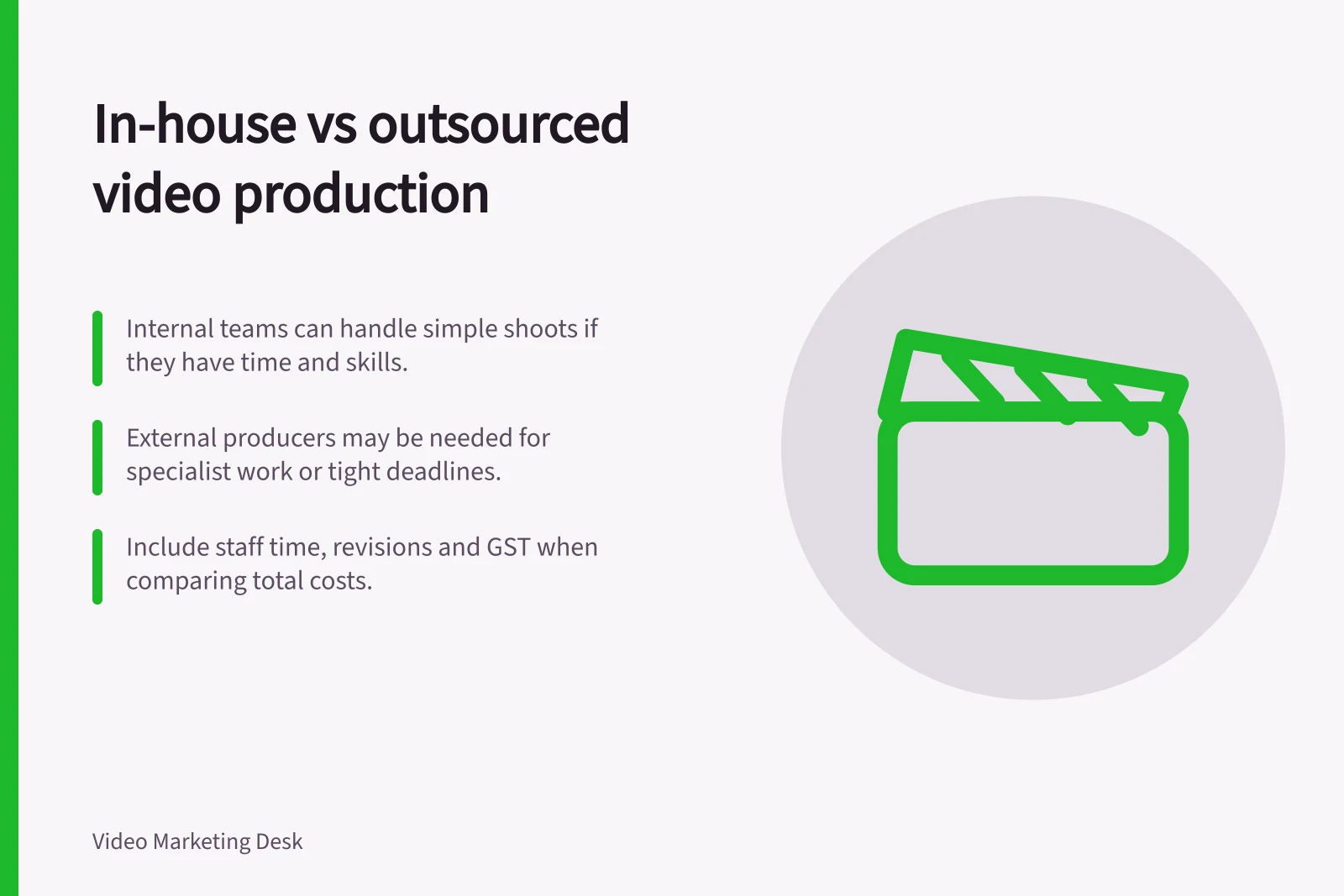
Compare both routes against the same small job: a staff interview in one room, edited into a short explanation. In-house production uses employee time and skills; outsourced production uses the supplier’s stated capacity while the business still supplies access, facts and approvals. A split is possible when staff prepare the material and an external specialist handles a defined production task.
Make the job comparable
For this comparison, keep the brief to a staff interview in one room and one finished short explanation. Specify the viewer question, people on camera, essential footage, accessibility needs and delivery date. State who supplies the script and product facts, and who approves the claims.
The in-house route draws on employees who know the people and setting, but they need the time and skills to film and edit. An external producer may supply capture or editing capacity; the business still arranges access and approves its claims. Use the same brief to define the work on both routes.
Compare the full resource picture
In-house, count employee time for planning, filming, footage handling, editing, accessibility work and review, plus any hire or travel. Count staff time even when it does not create a new invoice. Confirm that employees have the required skills and availability, and identify what other work may move.
Outsourced, compare the supplier’s stated capture, editing and deliverable scope with the same brief. The business still spends time supplying facts, arranging access, coordinating participants and reviewing the result. Include that effort alongside the supplier’s itemised and total costs.
A written quote should describe the work clearly and itemise and total costs, including GST if applicable. Check any discussed variations or revisions, terms, start and finish dates, and quote expiry. An accepted quote becomes a legally binding contract.
For both routes, state who owns the captured footage and finished video in writing. For outsourced work, include the agreed ownership terms in the written scope or quote; do not treat file delivery as a substitute for stating them.
Choose for the constraint that matters
In-house can suit a repeatable job with straightforward access when staff have the filming and editing skills and can complete it without displacing a more important deadline. The team’s familiarity with the people and setting is useful, but it does not remove the need to allow time for editing and approvals.
Outsourcing can suit work that needs capacity or specialist skills the team lacks. Define whether the supplier handles capture, editing or both, and name the finished video and any accessibility deliverables in the scope. An external booking still needs a knowledgeable internal owner.
A split route can keep facts and participants with staff while a specialist handles the part that would otherwise block the job. Assign each hand-off, including who supplies approved copy and who receives the agreed final files.
Make the decision on one page
For each route, record cash cost, internal time, a credible delivery date, the main uncertainty, the agreed deliverables and who owns the footage and finished video. For the shared brief, consider captions or subtitles and a transcript; a descriptive transcript also describes visual information, and sign language may be needed for some audiences. Plan any integrated visual description in the script before filming, and use a media player that supports accessibility. Choose the route—or split of tasks—that can deliver the agreed work within available capacity.