Scripts and Storyboards
Part of Customer case study videos
Preparing interview questions that produce specific answers
Use open questions and focused follow-ups to record a customer’s real experience without scripting praise or guessing at results.
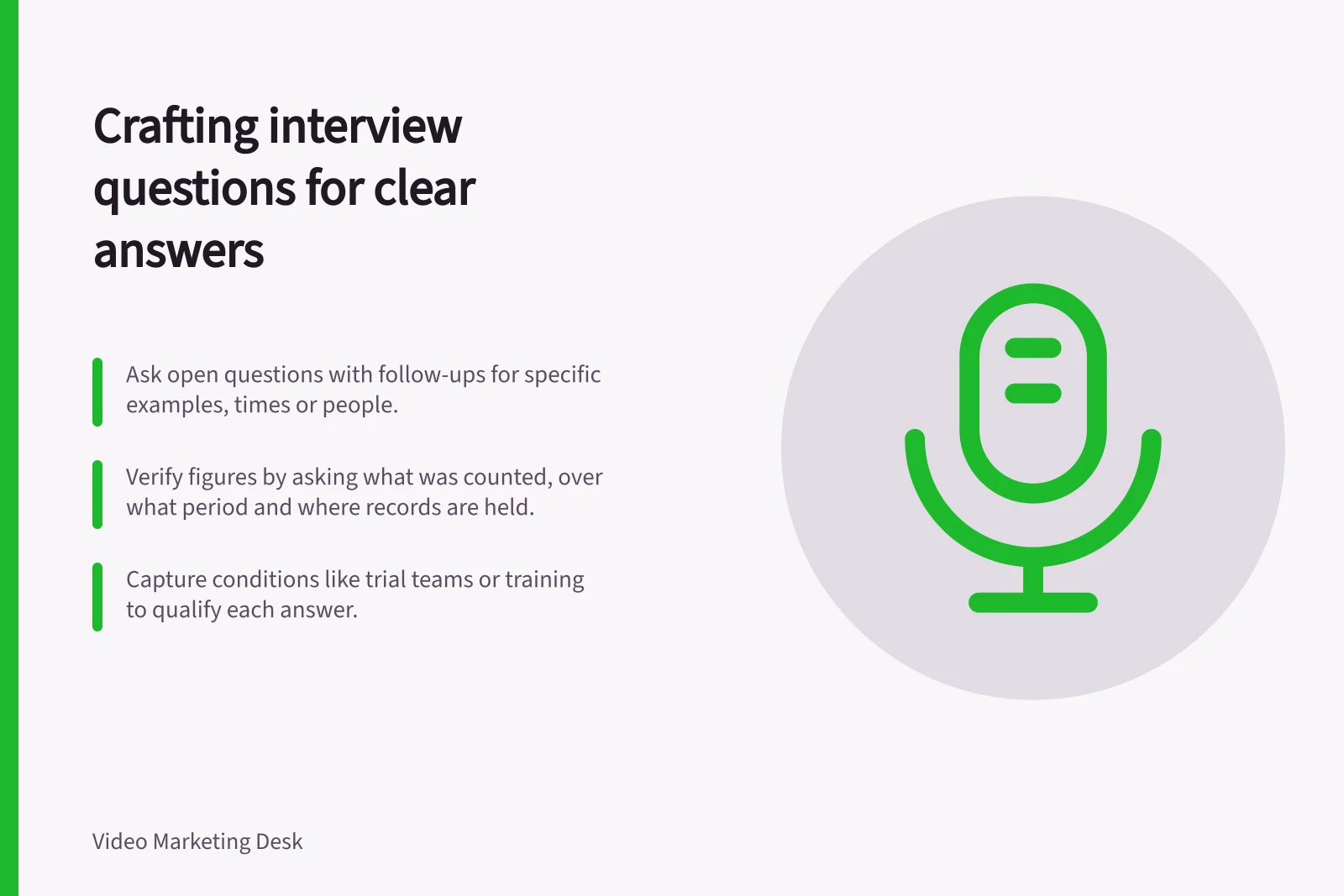
Prepare a customer case interview with open questions and follow-ups that ask for an example, a time, a person or a specific change. Let the customer describe what happened in their own words. A question that supplies the praise you want gives you less dependable material.
Start with the viewer’s question
Write down what a prospective buyer needs to know — perhaps the customer’s internal work during a rollout or how the customer judged the outcome. Keep the interview focused on that decision.
Separate facts already in project records from matters only the interviewee can describe. Mark figures and sensitive topics for later verification by someone with access to the records.
Share themes beforehand so the participant can prepare examples without memorising an endorsement. Invite them to pause, correct an answer or say when something is outside their knowledge.
Pros and cons of using open-ended questions in customer interviews
- ProsEncourages natural storytelling, reveals authentic experiences, reduces scripting bias
- ConsMay require more time to extract precise details; risk of vague or off-topic responses without follow-ups
Use a question ladder
| Topic | Open question | Useful follow-up |
|---|---|---|
| Starting situation | What was happening before the project? | Which team or task was affected? |
| Decision | What led you to consider this approach? | What did you need to check first? |
| Work | What changed during setup or delivery? | Who did which part, and what was difficult? |
| Experience | What is different in day-to-day work? | Can you describe a recent example? |
| Limit | Where does the approach still need adjustment? | Does that affect everyone or one group? |
Ask one question at a time. After a broad answer, ask for the most recent occasion that illustrates it. If the participant cannot give an example, leave the point general; do not invent a scene to fill the gap.
Probe a result without turning recollection into proof
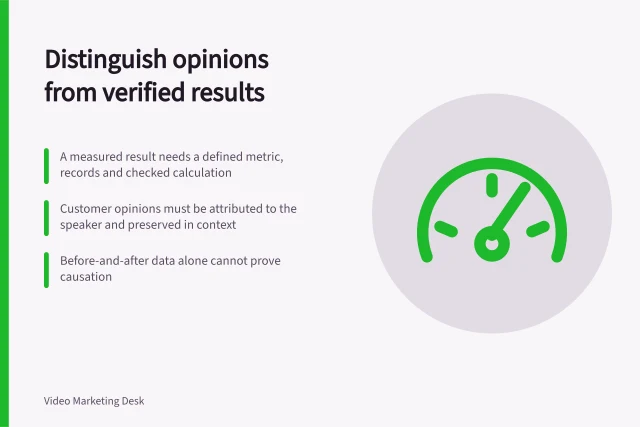
If someone mentions a number, ask what was counted, over which period, for which group and where the record is held. Ask what else changed at the same time. The answer identifies a claim to check; it does not verify the calculation or establish cause.
Do not press for an estimated percentage on camera. A genuine opinion can be useful when attributed as that person’s experience. Flag any claimed figure for substantiation before publication.
Key guidelines for verifying claims in customer interviews
- Ask about measurement context
- What was counted? Over which period? For which group?
- Check for confounding factors
- What else changed at the same time?
- Flag unverified claims
- Do not publish estimated percentages without substantiation
Capture conditions and complete answers
Listen for limits such as a trial team, one location, training or a continuing manual step. Keep the condition with the answer it qualifies. If a short answer says “it was faster”, ask what “it” refers to and whether the speaker means a personal impression or a recorded measure.
Ask the participant to name the task or team when their answer would otherwise lose its subject after the question is removed. Seek a complete answer in their natural wording.
After filming, retain the original question and surrounding answer with each selected passage, and mark claims needing records or customer review. That gives the editor usable context without scripting testimony.